In Brief
- A thirst trap works when it feels confident, not forced.
- Lighting shapes mood; angles shape the story.
- Over-editing kills authenticity — subtlety wins.
- The goal isn’t perfection; it’s reaction and connection.
- Dignity comes from intention, boundaries and self-awareness.
See also: How to Prepare for Your First Gay Sauna Visit
Why Are Thirst Traps Such a Big Part of Gay Culture?
Gay men have always communicated through visuals — whether through fashion, coded signals, body language, or subtle cruising cues. The modern thirst trap is simply the digital evolution of that instinct. It’s part flirtation, part performance, part self-celebration. And unlike straight dating culture, where thirst traps often come wrapped in layers of irony or denial, gay men tend to embrace them with honesty. A thirst trap is allowed to say exactly what it is.
On social media, the thirst trap becomes a micro-moment of connection: a wink across the room, but broadcast to hundreds. Sometimes it’s for one specific man; sometimes it’s for an entire audience; sometimes it’s just for yourself, a record of a day when you felt good. Gay culture has always played with exaggeration, sensuality and a touch of theatre — a great thirst trap hits all three without tipping into parody.
At their best, thirst traps aren’t about narcissism. They’re about visibility in a world that didn’t always allow queer men to take up space. They’re about pleasure, confidence and a sense of humour. They’re also about crafting your digital presence with the same self-awareness you bring to cruising, chatting or flirting offline. When it’s done well, the thirst trap can be both empowering and entertaining — a playful way of showing the world how you wish to be seen.
What Makes a Thirst Trap Work — and Why Do Some Fall Flat?
A great thirst trap doesn’t scream for attention; it invites it. The difference between the two is intention. When a photo feels desperate, over-posed or emotionally frantic, the viewer senses it instantly. But when the photo feels relaxed, authentic and quietly confident, people lean in. The trap works not because you’re half-naked, but because the image radiates a certain energy.
This is where psychology comes in. People respond most to images that appear effortless, even if the effort behind them is deliberate. A “successful” thirst trap gives the illusion of capture rather than construction. You look good not because you’re posing hard, but because you seem entirely at ease in your own skin. The viewer’s curiosity is sparked by your comfort, not your body alone.
The core elements are simple: an expression that feels real, a setting that doesn’t distract, and a sense of narrative — even if the narrative is “I look good today.” If you scroll social media long enough, you’ll see this pattern: the pictures with the most impact aren’t necessarily the thirstiest. They’re the ones that feel the most you.
That’s why knowledge of confidence and body neutrality matters. Articles like Body Positivity in Gay Saunas show how empowerment comes from inhabiting your body rather than fixing it. The thirst trap is a continuation of that principle — not a competition, but a moment of personal expression.
How Does Lighting Transform the Mood of Your Photo?
Lighting is the secret lover in every successful thirst trap. It shapes the tone, mood, and emotional weight of the image before anyone notices your face or body. The wrong light can flatten you, wash you out or break the illusion entirely. The right light makes you look like you’ve stepped out of a music video.
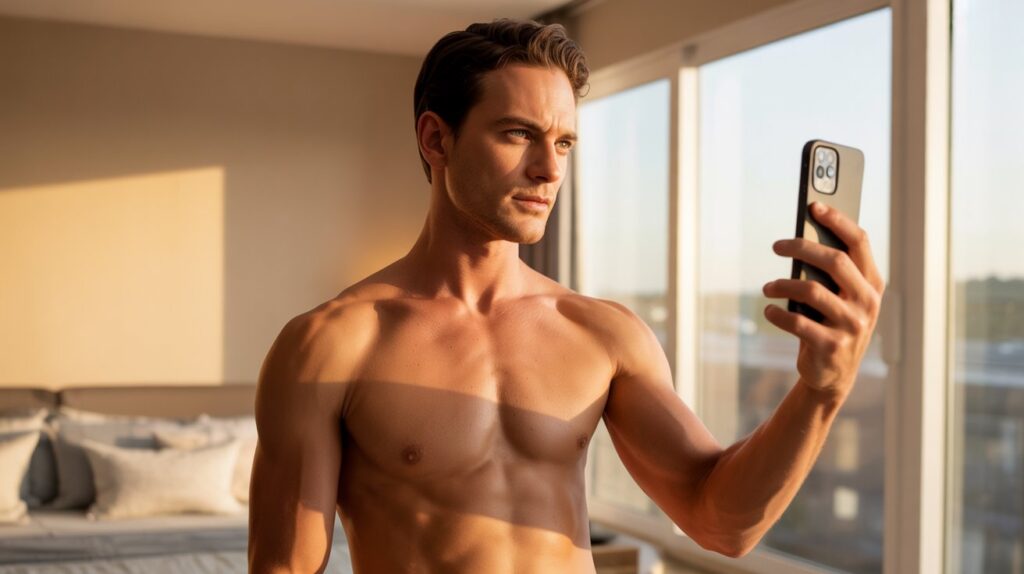
Natural light usually does the heavy lifting. Early morning or late afternoon sunlight softens skin, creates warm shadows and gives texture to muscle definition without harshness. If you’ve ever wondered why your body looks better in a changing room than under your bathroom ceiling bulb, it’s because overhead light punishes everything beneath it, while softer side-light treats you like a friend.
But lighting isn’t just about brightness. It’s about mood. Cool lighting makes you look fresh and sharp; warm lighting makes you look sensual. Shadows create mystery; bright light creates honesty. Even low-light images — the classic gym mirror or bedroom glow — can look striking if the contrast is intentional rather than accidental.
A good thirst trap doesn’t rely on luck. It relies on the moment when lighting aligns with intention. That’s when the photo stops being a snap and becomes a signal.
What Angles Highlight Your Best Features Without Over-Posing?
Angles tell the story your body wants to convey. A photo from slightly above suggests openness and approachability; a photo from slightly below adds strength and presence. Side angles create contour; straight-on angles create intimacy. You don’t need to learn modelling — you just need to understand how the camera interprets shape.
The best angle is the one that feels natural to you. If you feel awkward twisting your torso into a pretzel, the viewer will sense it. But if you find a stance that feels relaxed, the image will carry that energy. Confidence is visible through posture long before it’s visible through muscle or symmetry.
Think about how you stand when you feel good. Where are your shoulders? Where are your hands? What expression does your face settle into? These cues guide the camera more effectively than any tutorial. Angles aren’t tricks; they’re reflections of your physical comfort.
Even mirrors — gym, sauna, or bedroom — can help you see your own geometry. You learn which positions feel flattering because they feel right in your body, not because you’re forcing yourself into someone else’s aesthetic. The angle you choose becomes a statement: this is how I see myself today.
How Do You Keep Dignity While Still Being Sexy?
The thirst trap has two potential pitfalls: going too safe and losing impact, or going too far and losing dignity. The sweet spot lies between the two — suggestive without desperation, confident without arrogance, sensual without slipping into parody.
Dignity comes from intention. If you know why you’re posting, the image feels grounded. If the intention is impulsive validation, the viewer picks up on the fragility beneath it. But if the intention is playful, flirtatious or artistic, the reaction changes completely. You’re not begging for attention; you’re inviting engagement.
This also relates to boundaries. A thirst trap doesn’t mean baring everything — what you don’t show can be just as powerful. Implied nudity can feel sexier than explicit exposure. A hint of shadow, a cropped frame or a partially covered pose creates intrigue, maintaining your privacy and your dignity at once.
Discretion is part of mastery. This is why connecting to themes in the Gay Sauna Privacy: Discretion & Anonymity Guide can help frame your approach. Dignity isn’t about hiding; it’s about choosing what you reveal and why you reveal it.
A great thirst trap whispers. It never begs.
Should You Edit, Filter, or Keep It Natural?
Editing is where good thirst traps often lose their way. Filters can enhance a vibe, but they can also distort reality, creating an image that feels plastic or insincere. Strong filters flatten skin, remove texture, and make you look like a wax figure under soft lighting. Subtle adjustments tell a better story — brightness, shadow, contrast and warmth are your friends.
The key question is: do you want attention or attraction? Over-filtered photos may rack up likes, but they rarely build meaningful connection. Natural photos attract people who are responding to you, not your digital mask. That’s why authenticity is so important in queer spaces, especially when trust and honesty matter.
The article Profile vs Reality: Why Venues Beat Catfish Culture highlights this perfectly: people value genuine presentation far more than unrealistic digital perfection. Your thirst trap should enhance your truth, not rewrite it.
Editing is seasoning, not the meal. The goal isn’t transformation — it’s enhancement. The best edits disappear entirely into the image, leaving only your intention behind.
What Reaction Are You Really Hoping For?
Every thirst trap is a search for a reaction, but the type of reaction matters. Some men want desire; others want validation; others want fun; others want the thrill of anonymous admiration. There’s no judgement in any of these intentions — but understanding them changes how you create and share.
If you’re seeking connection, your photo will feel different from when you’re seeking attention. If you’re trying to impress someone specific, you’ll frame yourself differently than if you’re broadcasting to everyone. The intention shapes the tone, and tone shapes the image.
Self-awareness is the final component of a strong thirst trap. When you know your goal, everything — lighting, angle, pose, expression — aligns naturally. You aren’t scrambling for the perfect shot; you’re crafting a moment that expresses something honest.
A thirst trap isn’t a mirror. It’s a message. And like any message, its impact depends on clarity of intention.
Frequently Asked Questions
1. Do I need to be in perfect shape to take a good thirst trap?
Not at all. Confidence is far more influential than muscle definition. Lighting and angle help — but authenticity wins.
2. How much skin is too much skin?
Whatever crosses your own boundary of dignity. Implied nudity often looks better than explicit exposure.
3. Should I use filters?
Light editing is fine. Heavy filtering kills the realism and lowers trust.
4. Why do some thirst traps feel desperate?
The viewer senses anxiety or over-performance. A relaxed, confident tone feels more inviting.
5. Can thirst traps help my dating profile?
Absolutely — as long as they’re honest, flattering, and not misleading.
Conclusion
A thirst trap isn’t just a photo. It’s a blend of confidence, self-awareness, lighting, angles and emotional intention. It’s a playful act of self-presentation, not a desperate plea for validation. When done well, it becomes a moment of empowerment — a chance to express yourself visually in a culture where imagery has always been part of connection.
Sexy is not the pose. Sexy is the comfort within the pose. Dignity is not about hiding; it’s about choosing what you reveal and how you reveal it. Whether you’re sending a subtle hint to a crush or posting something bold for the world to enjoy, the art of the thirst trap lies in balance.
Not too forced, not too timid. Suggestive, not desperate. Confident, not arrogant.
A trap — with taste.